Workholding is rarely the first variable engineers examine when a machining operation produces dimensional errors, surface finish problems, or inconsistent cycle times — but it is often the root cause. Mechanical clamps that obstruct tool access, fixtures that introduce vibration under cutting loads, or setups that require significant reconfiguration between operations all add time and introduce error sources that compound across a production run. The Electro Permanent Magnetic Chuck has become a serious alternative to conventional workholding in CNC milling applications because it addresses several of these problems simultaneously — but understanding whether it fits a specific operation requires working through both the technology and its real-world performance limits.
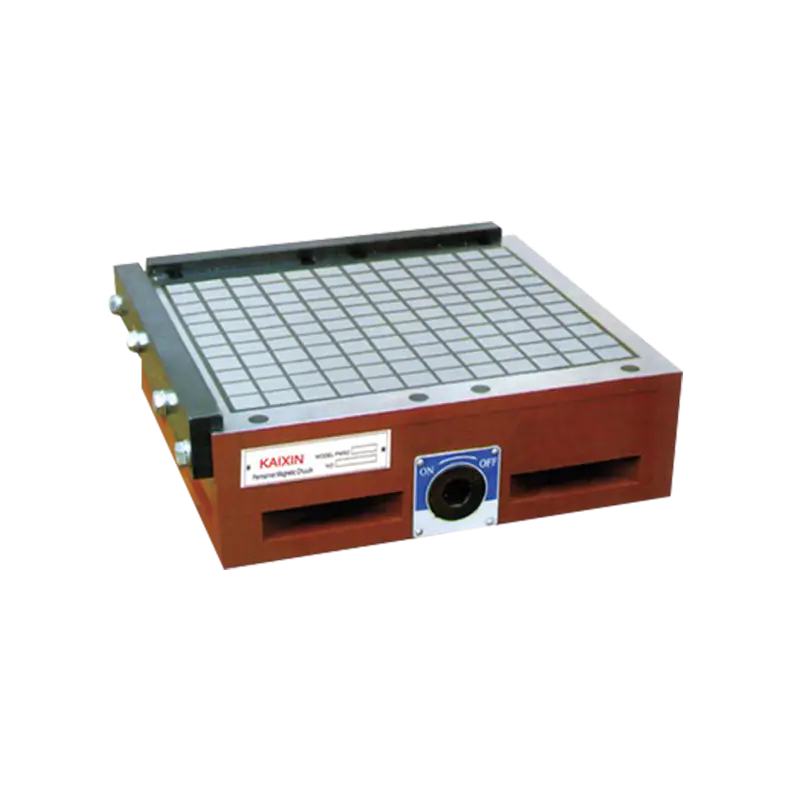
Milling imposes cutting forces in multiple directions simultaneously — the tool engages the workpiece laterally, axially, and radially as it rotates. A workholding system that handles linear grinding forces well may react differently to the interrupted, multi-directional cutting forces of a milling operation. The workholding must maintain rigidity against this force pattern across the full tool path without deflecting the workpiece or allowing micro-movement that shows up as surface error.
Mechanical clamping solves the force-resistance problem but creates its own complications:
These are not edge-case problems. They appear regularly in precision mold and die work, aerospace component machining, and any application where the workpiece geometry limits the accessible clamping area.
An Electro Permanent Magnetic Chuck combines two types of magnetic material — one whose field can be oriented by an applied electrical pulse, and one that maintains its orientation permanently without power. The chuck body contains an array of magnetic poles whose combined field can be switched between a holding state and a neutral state by applying a brief electrical pulse that reorients the variable-field material.
The switching sequence:
The practical consequence of this design is significant: the holding force does not depend on maintaining electrical power. A power interruption during machining does not release the workpiece. This is the fundamental safety advantage of electro permanent technology over electromagnetic chucks, where power failure immediately releases the held part — a safety hazard on vertical milling operations where the workpiece would fall into the spindle or onto the table.
The characteristics of electro permanent magnetic workholding align well with specific categories of CNC milling work. Understanding which applications benefit most helps identify where the investment is justified.
Precision surface and profile machining: Parts that require tight flatness, parallelism, or profile tolerances benefit from magnetic workholding because the chuck face distributes holding force across the entire contact surface rather than concentrating it at discrete clamp points. The even force distribution means the workpiece does not deflect toward the table under clamp pressure, which improves dimensional accuracy, particularly on thinner sections.
Multi-face machining in a single setup: Because magnetic chucks do not require physical clamps on or above the workpiece surface, the tool can access all five faces of a prismatic part without repositioning obstacles. This reduces the number of setups required to machine a complex part, which reduces both cycle time and the cumulative positioning error introduced by each re-clamping.
Thin and flexible workpiece clamping: Sheet metal parts, thin plates, and precision-ground flat stock are difficult to clamp mechanically without distortion. The distributed holding force of a magnetic chuck holds these workpieces without point-loading them, which is particularly relevant for parts that will be inspected for flatness after machining.
High-speed milling with vibration sensitivity: The broad contact area between the chuck face and the workpiece creates a damping effect that reduces vibration transmission during cutting. Operations that use high spindle speeds and light radial cuts — finishing operations, hard milling of hardened steels — benefit from reduced vibration at the workpiece, which improves surface finish and extends tool life.
Mold and die machining: Mold blocks require machining of multiple faces, complex profiles, and often internal features that require tool access from several directions. The ability to hold a mold block securely without clamps obstructing the work zone is a practical advantage in mold shops where setup time and multi-face access both matter.
The holding force generated by a magnetic chuck depends on the contact area between the chuck face and the workpiece, the material of the workpiece, the surface condition of both surfaces, and the magnetic circuit characteristics of the chuck design. These factors interact in ways that make theoretical holding force calculations only a starting point for evaluation.
Contact area and workpiece geometry: The holding force scales roughly with contact area. A small workpiece sitting on a large chuck will use only a fraction of the chuck's pole array, which reduces the available holding force proportionally. For operations where the workpiece does not cover most of the chuck face, the effective holding force is significantly lower than the chuck's rated figure.
Workpiece material: Magnetic chucks hold ferromagnetic materials — carbon steels, tool steels, cast iron, and some stainless steels. Non-ferromagnetic materials — aluminum, brass, copper, most austenitic stainless steels, titanium — cannot be held directly by magnetic force. Adapter plates or magnetic pallets are available for some of these materials, but direct holding is not possible.
Surface condition: Both the chuck face and the workpiece contact surface should be clean and reasonably flat. Burrs, scale, or significant surface roughness on either surface reduce effective contact area and therefore reduce holding force. For precision work, the workpiece reference surface should be ground or milled flat before chucking.
Temperature effects: Magnetic force decreases as temperature increases. In operations that generate significant heat at the workpiece, the holding force may decrease below what was measured at room temperature. This effect is more pronounced in electromagnetic chucks than in electro permanent designs, but it is relevant at elevated temperatures regardless of chuck type.
| Performance Dimension | Electro Permanent Magnetic Chuck | Electromagnetic Chuck | Mechanical Clamping |
|---|---|---|---|
| Power requirement during operation | None after activation pulse | Continuous power required | None |
| Safety on power failure | Workpiece remains held | Workpiece released — hazard | Workpiece remains held |
| Setup time per workpiece | Fast — single activation | Fast — continuous power | Slow — manual clamping |
| Tool access to workpiece | Full top and side access | Full top and side access | Restricted by clamp positions |
| Workpiece distortion risk | Low — distributed force | Low — distributed force | Moderate to high — point loading |
| Applicable materials | Ferromagnetic only | Ferromagnetic only | Any material |
| Vibration damping | Good | Good | Depends on fixture design |
| Residual magnetism in workpiece | Minimal — brief demagnetize cycle | Present — requires demagnetization | None |
| Maintenance requirements | Low — no wear components | Moderate — coil and electrical | Higher — mechanical components wear |
| Capital cost | Higher | Moderate | Lower |
The comparison highlights that the choice between these systems is not straightforward. Mechanical clamping works for any material and has lower capital cost. Electromagnetic chucks are simpler than electro permanent designs but introduce a power-failure risk that is unacceptable in many vertical milling applications. Electro permanent chucks address the safety concern while maintaining the access and setup speed advantages of magnetic workholding, at the cost of higher initial investment and restriction to ferromagnetic materials.
Understanding the distinctions between the three main types of magnetic chucks helps clarify why the electro permanent design occupies a specific position in the workholding market rather than simply replacing the other types.
Permanent magnetic chucks: Hold workpieces using the field of permanent magnets only. Activation and deactivation are typically mechanical — a lever or hand wheel repositions the internal magnets to switch the field on or off. Simple and reliable, with no electrical requirements. Primarily used in surface grinding applications where the workpiece is held on a large, flat surface and the machining forces are relatively predictable and consistent. Not typically used in milling because the mechanical switching mechanism does not provide the rapid, controlled activation and deactivation that milling workflow requires.
Electromagnetic chucks: Use an electrical coil to generate the holding magnetic field. Holding force is present only when power is applied. Widely used in surface grinding and some milling applications, but the power-failure hazard on vertical milling operations has driven many facilities to specify electro permanent alternatives for those applications. Electromagnetic chucks are generally less expensive than electro permanent chucks and are appropriate where the power-failure risk is manageable — horizontal operations, grinding with controlled downward forces.
Electro Permanent Magnetic Chucks: Combine permanent and switchable magnetic materials as described above. Activate and hold without continuous power. The safety, efficiency, and access characteristics described throughout this discussion apply to this type specifically. The higher complexity and cost reflect the additional engineering required to achieve the combined permanent holding and electrical switching capability.
Selecting a chuck without working through these variables typically results in either an under-specified product that fails to hold securely or an over-specified product that adds cost without benefit.
Step 1: Confirm workpiece material compatibility.
If the workpiece is ferromagnetic, magnetic workholding is a candidate. If it is not, mechanical or vacuum fixturing is required. For mixed material operations, identify which workpieces will be held magnetically and ensure the chuck is evaluated against those specific materials.
Step 2: Determine the required holding force.
Calculate the cutting forces for the intended operations and apply an appropriate safety factor. The chuck's holding force must exceed these forces across the full range of operating conditions, including worst-case scenarios with the smallest workpiece footprint on the chuck face.
Step 3: Define the workpiece footprint and geometry.
The contact area available between the workpiece and chuck face determines the effective holding force. For workpieces that do not cover the full chuck face, the actual holding force will be proportionally lower than the chuck's rated figure. Confirm that the available holding force at minimum contact area still satisfies the requirement from Step 2.
Step 4: Evaluate pole pitch and workpiece wall thickness.
The spacing between magnetic poles in the chuck determines the minimum wall thickness of a workpiece that can be effectively magnetized. Workpieces thinner than the pole pitch may experience reduced holding force because the magnetic circuit does not pass through enough material to create a strong return path.
Step 5: Assess the machining environment for temperature and coolant.
Confirm that the chuck's operating temperature range encompasses the expected workpiece temperature during machining. Verify that the coolant system being used is compatible with the chuck's sealing and construction — magnetic chucks used in wet machining environments need appropriate protection for their internal components.
Step 6: Review interface requirements.
Confirm that the chuck dimensions and mounting interface are compatible with the CNC machine table — T-slot spacing, table dimensions, and any height constraints from the machine's Z-axis travel.
The holding force and consistency of a magnetic chuck depend on the precision with which the internal magnetic array is manufactured and assembled. Variations in the quality of the permanent magnetic material, the geometry of the pole array, and the accuracy of the switching coil winding all affect how the chuck performs compared to its specifications.
Key evaluation points for a manufacturer:
The decision to adopt magnetic workholding in a CNC milling operation is not a universal recommendation — it is a fit assessment based on specific workpiece materials, geometry, cutting forces, and operational priorities. For operations involving ferromagnetic workpieces, precision requirements that are degraded by point-load clamping, or multi-face machining workflows where clamp repositioning consumes significant setup time, an Electro Permanent Magnetic Chuck addresses real operational problems with a measurable effect on cycle time, accuracy, and setup efficiency. For operations involving non-ferromagnetic materials, very small workpiece footprints, or lower-criticality clamping requirements, the investment is harder to justify against simpler alternatives.
Zhejiang Three-gold Magnetic Machine Co., Ltd. manufactures Electro Permanent Magnetic Chuck systems designed for CNC milling, grinding, and precision machining applications. Their product range covers standard and custom pole configurations, controller systems with CNC interface capability, and chuck designs suited to both general machining and high-precision toolroom environments. For engineers and procurement teams evaluating magnetic workholding for a CNC milling application, reaching out to their technical team to discuss workpiece requirements, holding force calculations, and machine interface specifications is a practical starting point for determining whether their products fit the specific operational context.



PRODUCTS

CONTACT US
Copyright @Zhejiang Three-gold Magnetic Machine Co., Ltd. All rights reserved
Magnetic Lifting Tools Manufacturers


 English
 中文简体
中文简体
 русский
 عربى
عربى