Holding a workpiece firmly in place is essential during grinding and machining. Traditional clamps can get in the way, especially when a large portion of the workpiece surface needs to remain accessible. A magnetic chuck solves this problem by using magnetic force to hold suitable metal parts against a flat working surface.
It is commonly used in surface grinding, toolmaking, milling, and precision manufacturing. Not every metal can be held this way, though. Material type, workpiece thickness, surface condition, and machining forces all affect whether magnetic workholding is suitable.
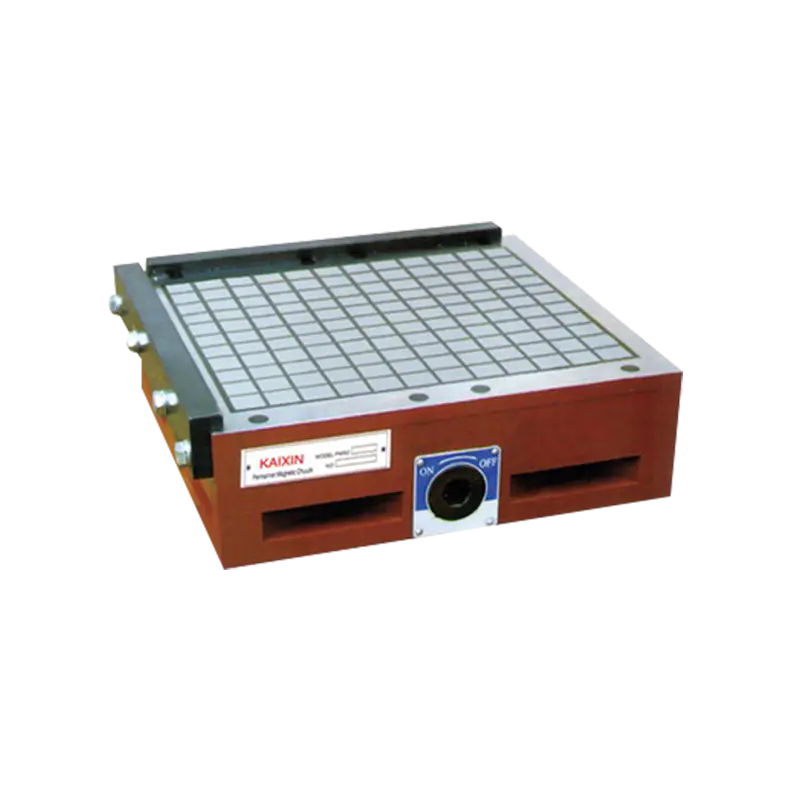
What Is a Magnetic Chuck and What Does It Do?
A magnetic chuck is mounted on a machine table and holds ferromagnetic workpieces through magnetic attraction. Carbon steel and many alloy steels are suitable, while aluminum, copper, and most austenitic stainless steels cannot be held directly by conventional magnetic chucks.
One reason manufacturers use magnetic chucks is that they leave more of the workpiece exposed. There are no large mechanical clamps blocking the cutting or grinding area. They can also hold several small parts at once, provided the available magnetic holding force is sufficient.
Another advantage is the distribution of clamping force across the contact surface. This can reduce localized stress that sometimes causes thin workpieces to deform under mechanical clamping.
How Does a Magnetic Chuck Generate Holding Force?
Inside the chuck, magnets or electromagnetic coils create a magnetic circuit. Magnetic flux travels through the chuck's pole surface and into the workpiece, pulling the part against the fixture.
The actual holding force varies with the setup. Several details make a noticeable difference:
This is why a chuck's advertised holding force should not be treated as a guarantee for every workpiece. The actual setup needs to be evaluated before machining begins.
Main Types of Magnetic Chucks
The main difference between magnetic chuck designs is how their magnetic field is generated and switched.
Permanent Magnetic Chuck
Permanent magnetic chucks use built-in magnets and do not need continuous electrical power. Many models have a mechanical lever that switches the magnetic circuit between holding and release.
They are commonly used for surface grinding and general precision work. Their relatively simple construction also makes them convenient where electrical control is unnecessary.
Electromagnetic Chuck
An electromagnetic chuck uses energized coils to generate its holding force. The magnetic field can be switched through an electrical control system.
This arrangement is common in production grinding, where operators need electrical control over workholding. The main consideration is power reliability. The system needs suitable protection and a clearly defined response to power failure.
Electro-Permanent Magnetic Chuck
An electro-permanent chuck uses permanent magnets controlled by electrical pulses. A short pulse switches the chuck between its magnetic states. Once activated, it can maintain holding force without a continuous power supply.
This makes it useful in automated machining and production setups where secure holding and electrical control are both required.
Comparing Magnetic Chuck Types
| Chuck type | Power requirement | Main advantage | Typical application |
|---|---|---|---|
| Permanent magnetic | No continuous power | Simple operation | Surface grinding |
| Electromagnetic | Requires power while holding | Electrical switching and control | Production grinding |
| Electro-permanent | Short switching pulse | Holds without continuous power | Automated machining |
The choice depends on the machine, workpiece, production volume, and required safety arrangements. A more complex chuck is not necessarily needed for a straightforward grinding operation.
Choosing a Magnetic Chuck for Your Machining Application
Start with the workpiece rather than the chuck catalogue. Its material, dimensions, and contact surface determine whether magnetic workholding will work properly.
Material: Confirm that the workpiece is sufficiently magnetic. Some stainless steel grades have weak or negligible magnetic response.
Maintenance and Safe Operation
Chips and grinding debris should be removed from the chuck surface before loading a workpiece. Even small particles can create gaps between the two surfaces and reduce holding force. The workpiece itself should also be clean and reasonably flat.
Inspect the chuck regularly for corrosion, surface damage, and wear. Electromagnetic models need additional checks of their power connections and switching controls. Mechanical switching components on permanent magnetic models should also move freely.
During operation, never assume that switching the magnet on guarantees a secure setup. Check that the workpiece is properly seated and held before starting the machine. Heavy parts, irregular shapes, and aggressive cutting operations may require additional mechanical support.
Using Magnetic Chucks for More Efficient Machining
Magnetic chucks make it easier to grind or machine ferromagnetic parts without covering their working surfaces with clamps. But the results depend on matching the chuck to the workpiece and the machining process.
When purchasing one, pay attention to magnetic holding capacity, pole arrangement, chuck dimensions, switching method, and machine compatibility. Proper installation and regular cleaning are just as important. A poorly seated workpiece can move during machining, regardless of the chuck's rated magnetic force.



PRODUCTS

CONTACT US
Copyright @Zhejiang Three-gold Magnetic Machine Co., Ltd. All rights reserved
Magnetic Lifting Tools Manufacturers


 English
 中文简体
 русский
 عربى