A batch comes back from the machine, and the inspection report shows flatness drifting just outside tolerance. Nobody touched the program. Nothing about the material changed. And yet the parts won't sit true on the granite plate anymore. If that sounds familiar, you already know the frustration isn't really about the cutting tool — it's about what's holding the workpiece while the tool does its job, and whether an Electro Permanent Magnetic Chuck could have kept things from shifting in the first place. Flatness problems rarely announce themselves loudly. They creep in through small deflections, uneven clamping pressure, or a fixture that was never quite matched to the grade of accuracy the job demanded. So before jumping to a fix, it helps to slow down and actually look at what flatness means, how grades separate one job from another, and where the real errors tend to originate.
Flatness, in plain terms, describes how close every point on a surface sits to a single reference plane. It sounds simple enough on paper. In practice, though, a surface that looks flat to the eye can still wander by amounts that matter enormously once parts need to mate, seal, or slide against something else.
Think of it less as a single number and more as a boundary — an imaginary envelope the entire surface has to live inside. Push even one corner outside that envelope, however slightly, and the part fails inspection, no matter how good the rest of the surface looks.
A few things tend to push a surface out of that envelope:
None of these show up clearly until the part is off the machine and cooling down, which is exactly why flatness issues often get blamed on the wrong stage of the process.
Here's the thing people new to machining often miss: not every part needs the same level of flatness. A structural bracket and an optical mounting plate live in entirely different worlds, even if they came off similar machines. Grades exist precisely to separate those worlds, giving engineers a shared language for "how flat is flat enough."
Lower grades tolerate more deviation and suit components where mating surfaces aren't especially sensitive — brackets, housings, general fixtures. Move up the ladder, and grades start demanding surfaces that behave almost like reference standards themselves, the kind used in sealing faces, measuring tools, or components stacked in assemblies where cumulative error can't be allowed to build up.
The practical takeaway is this: chasing a tighter grade than the application actually needs adds cost and cycle time without adding value. Chasing a looser grade than needed, on the other hand, sets a project up for rework, mismatched assemblies, or premature wear once the part goes into service. Grade selection, in other words, is a negotiation between function and cost — not a checkbox to fill in without thought.
It's tempting to treat flatness as purely a machine-tool problem, something solved by a stiffer spindle or a better-calibrated axis. That's only part of the picture, though. Errors creep in from at least two directions, and ignoring either one leaves half the problem untouched.
The machine itself contributes through spindle runout, guideway wear, thermal drift as components heat up during a shift, and vibration coming from nearby equipment or even the cutting process itself. These factors are usually well understood, and most shops have maintenance routines built around managing them.
What gets less attention, oddly enough, is the fixture. A workpiece clamped unevenly will deform under pressure, cut true while held, and then spring back out of shape the moment it's released. Mechanical clamps, in particular, tend to apply force at a handful of discrete points rather than spreading it evenly, which is exactly the kind of localized pressure that distorts thin or delicate sections.
This is where workholding stops being a supporting actor and starts becoming the main variable worth examining.
Picture two identical parts, cut on the same machine, with the same program, the same tool, the same operator. One comes out flat within tolerance. The other doesn't. What changed? Often, it's nothing more than how each part was held down.
A fixture that concentrates force in a few spots invites distortion. One that distributes holding force evenly across the whole contact surface tends to leave the part in something closer to its natural, unstressed shape once it's released. That difference alone can move a batch from marginal to consistently acceptable — without touching a single cutting parameter.
This is also where magnetic workholding earns its place in the conversation, not as a novelty but as a practical answer to an old problem.
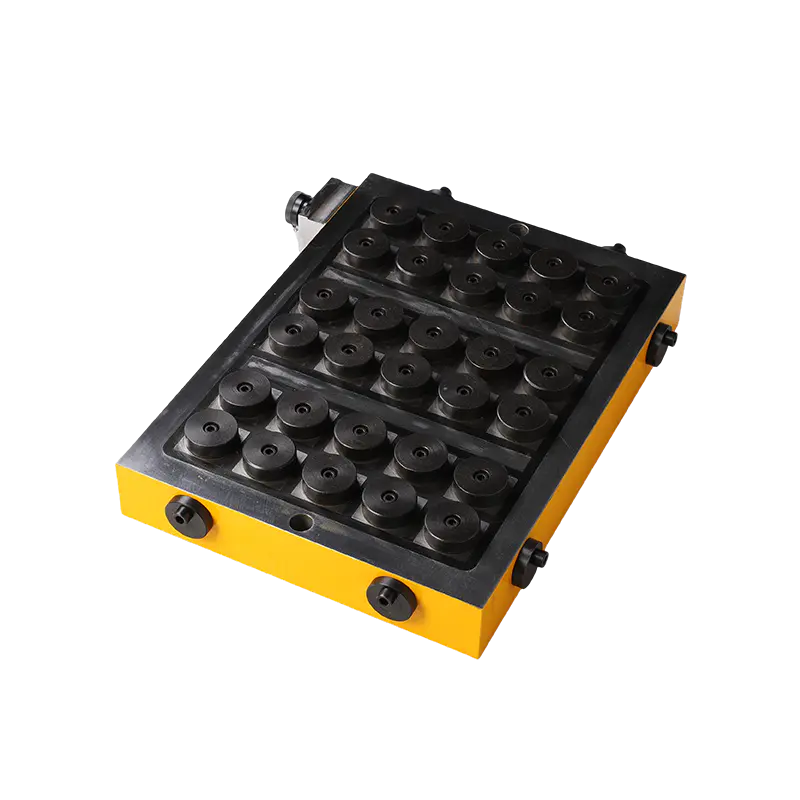
An Electro Permanent Magnetic Chuck holds a workpiece through magnetic flux spread across the full contact area rather than through mechanical pressure points. Because the holding force isn't concentrated at a few spots, thin plates and delicate sections are far less prone to the kind of localized bending that mechanical clamps tend to introduce.
There's also a practical convenience worth mentioning: once magnetized, this type of chuck holds its state without continuous power draw, switching only briefly to engage or release. That matters on a shop floor where downtime and power interruptions aren't purely theoretical concerns.
None of this makes magnetic workholding a universal answer — non-ferrous materials, for instance, still need a different approach entirely. But for ferrous parts where flatness stability across a full contact face is the goal, it solves a problem that mechanical fixtures have struggled with for a long time.
| Workholding Approach | Force Distribution | Typical Risk to Flatness | Suitability |
|---|---|---|---|
| Mechanical clamps | Concentrated at contact points | Higher, especially on thin sections | General fixturing, robust parts |
| Vacuum fixtures | Even across sealed area | Lower, but limited by seal quality | Flat, non-porous surfaces |
| Electro Permanent Magnetic Chuck | Even across full ferrous contact area | Lower for thin or delicate ferrous parts | Precision ferrous workholding |
So how does a buyer actually decide what grade to target and what fixture to pair with it? A few questions tend to cut through the noise:
Answering these honestly usually points toward whether the problem sits in the machine, the program, or the fixture — and more often than people expect, it's the fixture.
Before committing to a workholding solution, it's worth stepping back and confirming a handful of practical points rather than relying on assumptions:
These aren't abstract questions. They're the kind of checklist an engineer walks through with a supplier before a single part gets cut, and skipping them tends to be exactly how mismatched fixtures end up on a shop floor in the first place.
Flatness problems, at the end of the day, rarely come from one dramatic failure. They build up from small, uneven forces that nobody notices until the inspection report tells the story. Getting precision grade differences right means matching tolerance to function rather than defaulting to whatever grade seems safest, and getting workholding right means choosing a system that treats the whole surface fairly rather than a handful of contact points. For manufacturers weighing these decisions, Zhejiang Three-gold Magnetic Machine Co., Ltd. works with production teams to match magnetic workholding solutions to the flatness and grade requirements each job actually calls for — reach out to talk through a specific application and find a fixture approach that fits it properly.



PRODUCTS

CONTACT US
Copyright @Zhejiang Three-gold Magnetic Machine Co., Ltd. All rights reserved
Magnetic Lifting Tools Manufacturers


 English
 中文简体
中文简体
 русский
 عربى
عربى