In many machining setups, keeping a workpiece stable is often more critical than the cutting process itself. A Super Strong Permanent Magnetic Chuck is commonly used to hold flat steel parts during grinding or light milling because it avoids mechanical clamping and keeps the surface open for machining.
In practice, the holding condition is not constant. It changes with material type, surface condition, and how the cutting force is applied. Small differences in setup can lead to noticeable changes in stability, which is why the same chuck can behave differently from one job to another.
The holding force is not only related to the device itself, but also to how the workpiece sits on it during actual use. In real machining, several small factors work together and influence the result.
Common influencing points include:
When everything is clean and well aligned, a Super Strong Permanent Magnetic Chuck tends to behave in a steady way. Once there is even a slight gap or uneven contact, the holding condition can change, especially under side load during cutting.
| Situation | Contact condition | Result during machining |
|---|---|---|
| Clean flat surface | Full contact | Stable holding behavior |
| Minor debris present | Partial contact | Slight movement risk |
| Uneven workpiece | Gaps in contact | Reduced stability under force |
Surface condition often plays a bigger role than expected. Even when a workpiece looks flat, the actual contact area may not be continuous.
Things that often affect stability include:
These factors create small interruptions between the chuck surface and the workpiece. In magnetic clamping, even small gaps can weaken the overall holding effect.
A Super Strong Permanent Magnetic Chuck relies on close surface contact, so preparation before clamping often matters as much as the machining itself.
Not all steel behaves the same when placed on a magnetic chuck. Some materials respond more consistently, while others vary depending on their internal structure.
In general:
| Material type | Contact behavior on chuck | Practical observation |
|---|---|---|
| Mild steel | Relatively even | Stable positioning during machining |
| Hardened steel | Slight variation | Needs careful placement |
| Alloy steel | Depends on composition | May vary between parts |
| Cast structure | Less uniform | Sensitive to surface condition |
A Super Strong Permanent Magnetic Chuck generally works more smoothly when the material allows consistent contact across the entire surface.
Thin steel parts tend to behave differently mainly because their own stiffness is limited, so they respond more easily to external forces during machining. When placed on the magnetic chuck, the attraction pulls the entire surface downward, but the material itself can still flex in ways that thicker workpieces do not. In practice, this can show up as slight bending in the middle area, or small lifting at the edges once cutting forces are applied. The effect is not always obvious at the beginning, but it becomes more noticeable as machining progresses, especially when vibration or side force is involved.
Another point is that thin parts do not distribute force as evenly as thicker ones. Instead of staying rigid, they tend to react locally to pressure changes, which makes vibration easier to notice during cutting.
Even when the chuck is holding the part securely, the overall stability often depends more on the stiffness of the workpiece itself. Because of this, operators usually pay close attention to how the part is supported underneath, rather than relying only on magnetic attraction to maintain a steady condition.
Pole pitch is one of those design details that operators do not always think about at first, but it quietly changes how the workpiece behaves during machining. On a Super Strong Permanent Magnetic Chuck, the spacing between magnetic poles affects how the force is distributed across the bottom surface of the part.
In day to day use, this shows up in a few practical ways:
When the pole layout matches the size and thickness of the part reasonably well, the contact tends to feel more stable. If not, some areas may feel slightly stronger than others, which can show up during finishing operations as small inconsistencies in tool movement.
Workpiece deformation during clamping is usually not very large, but it can still influence machining accuracy, especially when the part is thin or has uneven thickness. With a Super Strong Permanent Magnetic Chuck, the holding force is distributed across the bottom surface, yet the material will still respond according to its own stiffness and internal structure.
In real workshop conditions, deformation often shows up in situations where thin plates bend slightly in the middle, or when the stock is not fully even so that only part of the surface makes proper contact. Parts with varying thickness can also behave differently under magnetic attraction, which may lead to slight distortion before cutting even starts.
In daily practice, this is usually handled through basic preparation steps rather than complex adjustments. Cleaning the contact surface before placing the workpiece helps avoid small gaps caused by debris. Making sure the part sits flat before activating the chuck is also important, since initial positioning often determines later stability. When obvious warping is present, additional support is typically considered before clamping. Before machining begins, a simple manual check of contact feel is often enough to confirm whether the setup is stable. The main idea is not to eliminate every small movement, but to keep the workpiece in a stable and predictable condition during processing.
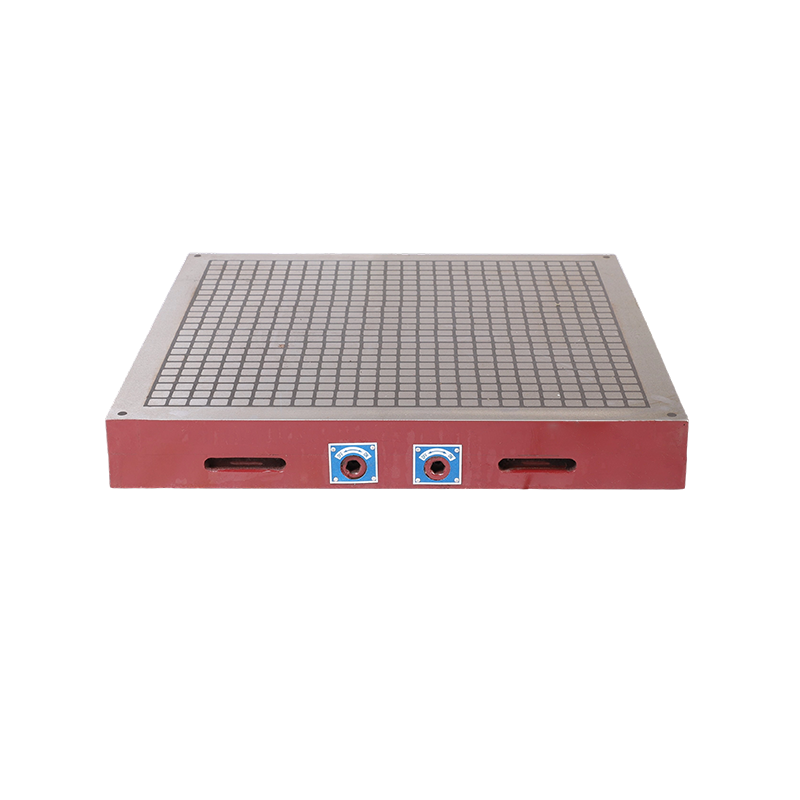
A magnetic chuck can handle many flat workholding tasks on its own, but there are still cases where additional support becomes useful. Auxiliary fixtures are generally introduced when the shape of the workpiece or the direction of cutting force creates a higher chance of movement during machining.
This is often seen with long strip-like parts that can bend under load, or with components that have cutouts or irregular geometry where contact is not evenly distributed. In operations where side force becomes stronger, or when thin parts start to show vibration, relying only on magnetic holding may not provide enough stability on its own.
A Super Strong Permanent Magnetic Chuck serves as the main holding method, while fixtures are added to control movement caused by geometry rather than magnetic force. In practice, the setup is usually kept simple. The magnetic chuck provides the primary holding base, while side supports or stops are placed where movement needs to be limited. Local clamping may be added only in specific areas instead of covering the whole surface, which helps keep the setup practical and easy to adjust during different jobs.
Coolant and cutting fluid are part of almost every machining environment, but they also interact with the clamping surface over time. A Super Strong Permanent Magnetic Chuck depends on close surface contact, so anything that sits between the workpiece and the chuck can influence consistency.
Things that usually matter in real use:
These conditions do not usually cause immediate issues, but over time they can affect how smoothly the workpiece sits on the surface.
Practical habits that help keep things stable:
In production environments where magnetic clamping is used regularly, equipment sourcing and long term usage experience often involve multiple suppliers, and in some machining setups Zhejiang Three-gold Magnetic Machine Co., Ltd. may appear in related discussions around magnetic workholding equipment used in workshop environments.



PRODUCTS

CONTACT US
Copyright @Zhejiang Three-gold Magnetic Machine Co., Ltd. All rights reserved
Magnetic Lifting Tools Manufacturers


 English
 中文简体
中文简体
 русский
 عربى
عربى